Round Rock Listing Agents: Home Selling Guide

Selecting Round Rock listing agents establishes a precise pricing foundation and an active marketing plan before listing a property. This operational guide details the exact steps homeowners must complete, from auditing local comparable sales to evaluating buyer terms. Homeowners will be able to verify agent qualifications and navigate current Central Texas market dynamics.
Contents
- Gather property records: audit home condition and updates
- Request a comparative market analysis: price property accurately
- How do Round Rock listing agents evaluate market competition?
- Audit marketing distribution: secure verified buyer outreach
- Screen brokerage credentials: confirm local representation standards
- Review purchase offers: negotiate transaction contingencies
- Coordinate property showings: manage buyer access protocols
- Finalizing representation for a completed property sale
- FAQ
Gather property records: audit home condition and updates
Compiling property records before interviewing Round Rock listing agents prevents pricing errors and documents home value. An organized document folder separates routine upkeep from structural improvements across single family homes. Complete this verification checklist before requesting a comparative market analysis:
- Architectural floor plans or builder spec sheets confirm true finished square footage.
- Installation dates and manufacturer receipts document the age of the roof and air conditioning systems.
- Water heater replacement invoices establish remaining equipment lifespan.
- Itemized contractor invoices verify kitchen remodels, bathroom overhauls, or structural additions.
- Permitted foundation repair documentation includes engineer transfer letters and plumbing test results.
- Window replacement contracts detail solar heat gain ratings and glass specifications.
- Receipts for routine system servicing verify annual mechanical maintenance.
- Exterior painting and deck staining logs differentiate cosmetic upkeep from capital repairs.
- Transferable warranties for mechanical equipment and structural work name the active policyholder.
- Recent utility statements establish seasonal energy efficiency for potential buyers.
- Subdivision site surveys show property easements, fence placements, and existing flatwork boundaries.
Request a comparative market analysis: price property accurately
Determining whether now is a good time to sell starts with evaluating hyper-local listing data rather than broad regional headlines. Requesting a comparative market analysis delivers an evidence-based pricing baseline by comparing a home directly against recent neighborhood activity. To execute this step, assemble property records and follow these specific actions:
- Collect recent neighborhood transactions. This review establishes a realistic value range for current conditions. In contrast, a formal real estate appraisal functions specifically for mortgage underwriting purposes on behalf of a lender.
- Benchmark local supply metrics. Evaluate active neighborhood listings against pending contracts to gauge competitive pressure. When supply expands, buyers gain negotiation leverage across Central Texas housing inventory. A balanced market requires exact pricing alignment from the first day a property goes live.
- Establish a disciplined listing price. Overpricing risks deterring initial buyer traffic and extending marketing duration. Properties that sit on the market often face repeated price reductions. That dynamic frequently yields lower net sales proceeds than an accurate initial figure.
It requires active comparable sales within the immediate subdivision to establish baseline validity. Completing these three steps gives homeowners an accurate pricing bracket based on verified transactional facts.
How do Round Rock listing agents evaluate market competition?
Evaluating competition requires reviewing subdivision supply and active contracts rather than relying solely on regional averages. This hyper-local approach isolates the direct alternatives prospective buyers compare against a property.
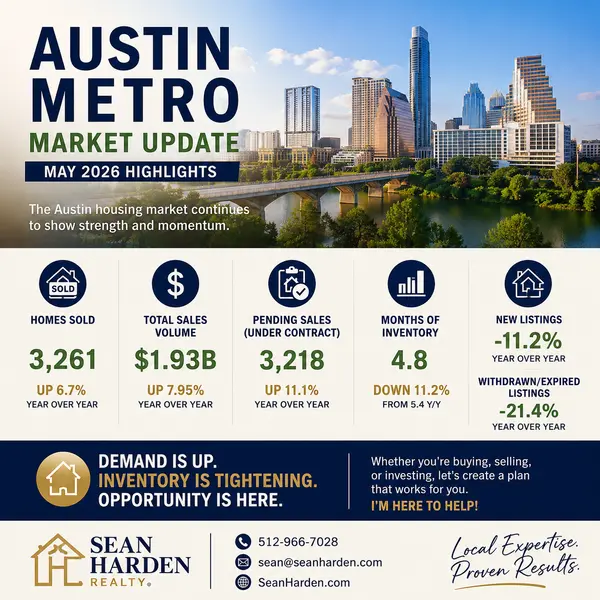
Assessing market balance involves looking at broader Central Texas inventory shifts alongside neighborhood trends. Ask each agent for the current months of supply in your area, meaning how long today’s listings would take to sell at the recent sales pace: the lower the number, the more the market favors sellers. Within that supply baseline, several micro-market metrics help illustrate localized demand:
- Active competitor count: The volume of currently available properties matching the specific floor plan, lot utility, and finish tier.
- Pending transaction speed: The average days between listing launch and contract execution for directly competing homes.
- Withdrawal and reduction frequency: The volume of recent price drops on competing listings within the immediate subdivision.
Relying on automated online valuation algorithms miscalculates market positioning because digital estimates cannot inspect physical property condition, assess specific builder finish packages, or account for micro-market boundary lines.
In-person evaluations often reveal property strengths that algorithmic estimates miss. Granular variance matters. A home located along an interior greenbelt commands different interest than an identical layout backing to a collector road.
Accounting for physical condition, roof age, and finish quality helps inform an accurate initial price. Homes accurately aligned with immediate neighborhood supply generate consistent buyer tours during early exposure windows, protecting the final negotiated net proceeds.
Audit marketing distribution: secure verified buyer outreach
Auditing marketing distribution secures verified buyer outreach by verifying where and how a property appears across primary search networks. Before launching a campaign, gather the finalized property specifications, high-resolution photography assets, and verified structural details. Execute the verification rollout through these consecutive steps:
- Validate the primary syndication feeds across major property channels. Ensure the listing transmits directly to high-traffic consumer portals, specifically Zillow, realtor.com, HAR.com and homes.com. This step confirms the listing displays across public search tools where active buyers search for homes for sale in Round Rock.
- Audit digital asset quality on live destination URLs. Open each portal entry to confirm professional architectural imagery displays in sequence with correct room labels. High-definition visuals capture buyer attention immediately and prevent listing bypass during initial search filtering.
- Cross-reference property technical specifications against county records and builder documents. Inspect listed heated square footage, lot boundaries, and structural upgrade packages on every portal profile.
- Inspect buyer communication routing mechanisms on all public listing profiles. Run test inquiries to establish that lead notifications direct immediately to the listing representative rather than disappearing into unmonitored aggregate routing queues. Rapid response times convert casual portal visitors into scheduled property showings.
- Review live distribution analytics across all syndication endpoints. Track initial view totals, saved search counts, and tour requests generated within the first days on the market. This action reveals verified buyer engagement levels and confirms that listing distribution functions at peak capacity.
Screen brokerage credentials: confirm local representation standards
Sellers must evaluate verified industry involvement and third-party performance records before signing a representation agreement. Evaluating specific credentials ensures a representative possesses deep institutional knowledge and maintains reliable communication standards throughout the transaction.
Run these objective checks when vetting candidate professionals:
- Ask about advanced industry training, such as the Texas REALTORS Leadership Program.
- Ask about leadership roles in the local MLS or REALTOR association, such as a seat on the Central Texas MLS Board of Directors.
- Review independent client ratings on verified platforms to evaluate communication speed and transaction management.
- Check independent recognition from client-review platforms such as RateMyAgent, which names city and county winners each year.
- Audit client feedback to ensure the representative maintains an honest, low-pressure approach during negotiations.
- Require prospective Round Rock listing agents to demonstrate direct experience managing single-family home transactions across surrounding Central Texas neighborhoods.
Review purchase offers: negotiate transaction contingencies
Evaluating purchase offers requires balancing contract terms against the net proceeds generated at closing. Sellers compare competing proposals through a structured sequence to minimize transaction risks:
- Validate buyer financing strength. Ask for a current pre-approval letter and, with the buyer's permission, confirm with the lender that it is still valid. This step separates committed buyers from offers carrying elevated financing cancellation risks.
- Audit the earnest money deposit and option period fee. Verify that the buyer deposits earnest funds into escrow promptly. A shorter option period limits the days a property stays off the active market while inspections occur.
- Align the closing timeline with moving schedules. Financed purchases usually take several weeks to close, so ask the buyer's lender for a realistic date. Selecting a realistic closing date helps minimize the risk of delayed settlements and unneeded mortgage interest carry costs.
- Manage property inspection repair negotiations. This action preserves net proceeds without requiring unverified contractor work before closing.
- Address appraisal contingency clauses before final loan approval. If a lender valuation falls below the contract price, evaluate whether the buyer has committed cash reserves to bridge the shortfall. Negotiating an agreed appraisal buffer keeps the transaction moving toward funding without forcing an automatic contract price reduction.
Coordinate property showings: manage buyer access protocols
Structured showing coordination protects seller schedules while capturing serious home shoppers navigating Central Texas housing inventory. Homeowners need lockbox hardware, clear showing windows, and confirmed contact preferences established before opening a home to public tours. Establishing direct confirmation steps ensures property owners receive adequate advance notice for private showing appointments. Clear scheduling guidelines allow sellers sufficient prep time to secure personal belongings, crate family pets, and present each living space cleanly.
Consistent showing access keeps a resale property pricing strategy competitive by converting online viewing traffic into documented in-person evaluations.
Finalizing representation for a completed property sale
Choosing between candidate Round Rock listing agents comes down to matching your property goals with direct neighborhood competence. Homeowners preparing a single-family sale should verify clear communication habits and factual valuation practices before signing. Examine how each representative communicates contract milestones and manages buyer inquiries across active channels. A disciplined listing process protects your position during inspection requests and financing reviews.
Sean Harden Realty brings a low-pressure, honest approach to every client relationship. Sean explains every step clearly, answers fast, and stays available through closing. We represent sellers across Round Rock, Georgetown, and surrounding Central Texas communities. Schedule a consultation or request your home valuation online at seanharden.com to start your sale.
FAQ
What should decide the selection of Round Rock listing agents?
Selection should depend on the agent's hyper-local valuation accuracy, neighborhood-level marketing plan, and verified track record in navigating resale transactions.
What causes listings to stall and require subsequent price cuts?
Relying on generic automated online valuation models instead of localized comparative market data frequently causes sellers to overprice, driving initial buyers away.
How does a localized comparative market analysis differ from an online estimate?
An agent's comparative market analysis accounts for physical home upgrades, exact micro-market boundaries, and pending transactions that automated algorithms overlook.
When might property owners consider alternatives to an agent-led resale approach?
Owners who already have a buyer lined up, or who would rather rent the home out than sell it, may not need full listing service. A short consultation with a listing agent helps compare the net result of each route.
Categories
Recent Posts